I. Allegro moderato
At night, it comes.
A breeze threaded with melody.
Textured with quavers and trills.
It sweeps over the hill, rolls across the moors, and slips through cracked bedroom windows, whispering sleepers awake.
The mayor lies in bed, staring at the ceiling, eyes wide with horror. His knuckles blanch with the tune’s pulse, bed sheets coiling, sweat-sodden in his hands.
Clench. Release.
The music stalks the corners of the room. A ghost. Relentless. It resonates in the wood of antique furniture and steals the last breaths from the hearth’s dying embers.
He turns to his wife, still sound asleep. The space between them yawns. That she does not wake is a wonder; that she is so distant, a burden.
A crotchet rest offers reprieve. He gasps.
His wife wakes with a graceless snort. “Is that–” Her voice thins. “No. No, it can’t be.” She turns to him for confirmation. Or for comfort.
He looks away.
The melody haunts the room, harmonising with others still ringing through the streets. How can such emotion come from a single instrument? Why has the maestro returned?
Outside, feet shuffle and garbs swish.
“The whole village will wake!” His wife’s voice is cacophonous. Distasteful.
He peels away his sheets and lets his legs drip off the bed. Floorboards groan as he crosses to the window and parts the drapes. Below him, silhouettes trickle into the street, all yawns and trembles. Men in nightcaps, women in shawls, children trailing blankies.
An incarcerated audience.
They look towards the moors. They listen.
“Don’t just stand there!” his wife snaps her fingers. “Norbert! Do something!”
The mayor descends the stairs, breathing out his regrets, and bursts onto the street.
The villagers pay him no heed. They can only listen.
The melody twists.
Glissandos into vibrato.
A double-stop.
A surprising shift to minor.
Parents clutch their children closer. Is it any wonder no one dares speak?
It wasn’t always so.
II. Adagio di molto
When the music started years ago, the villagers rejoiced. A maestro had come – to Hutton, or the next village over. What fortune!
Mothers coaxed children with forecasts of a lullaby. Perhaps the maestro will play for us tonight! Farmers debated the traits of virtuosity. Only a violin could accommodate such dexterity! The pastor preached the virtues of humility. Anonymity assures us of the maestro’s modesty!
It could be any of us, they thought.
Back then, the mayor was just a boy with no appetite for politics or ambition for leadership. Music had never left much mark. The villagers thought him a meanderer, typical for any coltish lad – wandering the streets barefoot, collecting pebbles as if they were coins.
His interests, however, were singular; his meandering, a ruse for time spent near a house at the village’s edge – a house with an oval attic window that overlooked the moors.
Sometimes a face would appear in that window like a portrait. A mess of hand-rubbed dark hair above a balanced brow. Freckles dusting a delicate nose-bridge. Black lashes fluttering above pale grey eyes that searched the moors as the sun set. It was for this face – this perfect face – that the boy parted with his pebbles, tossing them tenderly, each accompanied by a dangerous whisper. Thomas! Thomas! Thomas!
“Oh, Norbie!” A voice floated down from the window once it opened.
“What are you doing?” Norbie asked.
“Waiting,” the boy answered, now half-hanging out the opened attic window, all elbows.
“Waiting for what?” Maybe this time the answer would be different.
“Why, for the music to start, of course,” Thomas said, with a melodious laugh.
That Thomas laughed at all was a gift; that he should feel so near…
“Won’t you come down? Sit with me a while?” Norbie asked, like he’d always done.
“Mother says I can hear the maestro better here. Besides, she says I’m not to leave the house when she’s out at nights.”
Norbie knew better than to indulge in village gossip, and asked instead, “How can you be sure he’ll play tonight?”
“I just know,” Thomas sighed, looking to the moors. “I can’t explain it.”
Harmonics came, disguised as wind Norbie never could hear first.
“It’s starting,” Thomas said, brows furrowed, eyes squinting into the darkening moors. “Listen, Norbie. Isn’t it beautiful?”
“Yes,” Norbie whispered, looking only up to the attic window.
Sometimes Thomas would gasp. “Do you hear that? The slightest fermata?”
Norbie would nod enthusiastically. “Yes! The fermata!”
His parroting earned him eye contact and a smile. Can I fly?
One night, before the music started, Norbie stood below the attic window with something more precious than pebbles.
“Is that–” Thomas had already opened the window. “Norbie! Where did you–”
“I found it in the attic at home!” Norbie held the violin above his head by its neck. “I’m going to learn. I’m going to find the maestro!”
How Thomas looked at him then. I’m flying. He held the violin higher.
In the days and weeks that followed, Norbie tried every tune. But the notes would crumple between poorly woven catgut and a bow gripped too tight. His mother had chided him. One should play melodies, dear, not maladies. His father only laughed. Trying your luck with the carpenter’s daughter, are you?
He took their teasing for torment; it calcified his intent. Thomas! Thomas! Thomas! He couldn’t return to the black-haired, grey-eyed boy who knew which nights to wait at the attic window. Not yet.
But as more time passed without progress, without a glimpse of Thomas, Norbie began to understand he could never learn on his own.
By day, Norbie wandered shoeless and hunched. He marked the pebbles he might once have picked up but left them untouched. He avoided the house that straddled the moors, ashamed of the sounds he couldn’t yet make.
At night, after drills and scales, he waited at his own window to see if the maestro would play again. In the morning, only pleasant dreams and good rest reminded him of all he had missed.
If only he could find the maestro. Talk to him. Beg.
Then, one night, practice gave way to pain. The music began. He climbed out his window and ran, barefoot and breathless, far onto the moors, directionless and desperate in the dark, towards the music–
And learned only too late that he’d followed its echo. The music doubled back, circling him. He spun, unsure whether it was ahead or behind. It laughed in staccatos, leapt out of reach, then glissandoed away like sand sifting through splayed fingers.
Tears came unbidden, ugly and loud, scattered by an indifferent wind. In the blackness of the night he mourned a love that seemed written in counterpoint to nature’s key. Alone he mourned a future that might have been had the world’s tempo been a little faster.
Then, without warning, he broke. He cried out, his voice cracking against the maestro’s nocturne. The maestro played on.
He returned to his room and translated his anger into sounds he might understand. Wood snapping like dry bone, strings recoiling into silence, horsehair whipping and lashing the wall.
In the morning, his parents found him sitting amongst the splinters of his frustration, the violin now fragments of varnished spruce. Red-eyed and hoarse, he levelled his blame at the world. No! The maestro!
His father cuffed him. His mother wept.
The next day he wandered the village, collecting pebbles with which to reconvene with Thomas before nightfall.
“Norbie!” Thomas cried when he finally came to the window. “You came back!” How they had smiled at each other; Norbie nearly forgot…
“Will you wait again tonight?” Norbie asked.
“Yes, I’m sure the maestro will play tonight,” said Thomas, turning his gaze again to the moors and squinting into the setting sun.
“But he played last night. How do you know he’ll play again tonight?”
“You heard it too?” He turned back with a smile almost enough to tame the wildest tempest. “The nocturne? Oh, Norbie! Wasn’t it beautiful? Perhaps tonight the maestro will play a concerto. I heard Sibelius debuted his violin concerto in Helsinki. And they say the soloist couldn’t manage it! To be in Europe, Norbie! Can you imagine? Away from rotten mutton Hutton? But maybe the maestro will play it for us tonight. Wouldn’t that be something?”
“I like our village.” Norbie looked down and saw his bare feet still stained with the soil of the moors. “Hutton is our home.”
“Norbie? Whatever’s the matter?” Thomas’ smile faltered.
“How can you be sure the maestro is so good?”
Thomas hadn’t seen the rage in the undertones. He smiled instead. “Norbie! Of course the maestro could handle it! Besides, I’ve always found it funny you’ve thought the maestro a man. Haven’t you ever thought it might not be?”
“You’re right!” Norbie leapt at it like salvation. “No one knows who it is. For all we know,” he said, looking to the moors for confirmation, or comfort, “it could be the devil.” He looked back at Thomas and saw the terrible consequence of his accusation.
“Norbie!” Thomas cried, eyes shimmering in the setting sun. “What makes you think such an awful thing?” His voice, soft, stricken. “The maestro only plays so that we might listen. It uplifts our thoughts to the heavens. Music is the language of God!”
“Then why doesn’t he play in the chapel? Why does he play only for shadows in the night? Why hasn’t anyone caught the maestro?” Norbie’s voice rising.
“Caught?” A shift in volume, more unsettling than words. “Why would you want the maestro caught?”
“I just mean that,” Norbie stumbled, “he shouldn’t– why is– it’s not–” He could hear it then: a rogue instrument deviating from the Partitur. The rhythm. Off. “HE’S A COWARD!”
A silence, the kind that gives meaning to melody, shape to sound. It stretched between them. In this silence, Norbie finally began to understand. He saw laid before him the rest of the score, the coming movements. Coda. Each instrument had its own stave, not all carrying solos. Some moved in counterpoint, others as embellishment. Some simply counted bars of rest.
But not him.
“Norbie,” Thomas said finally, his voice trembling with grief. “Norbie, no. Of all you could choose, why would you choose to be cruel?”
“CRUEL? Is it not crueller to taunt…” He faltered, hoping Thomas’ reply might dovetail the pause. Save me, Thomas. I’m falling.
But he said nothing.
“I can’t learn alone. I’ve tried! Look!” He held up his fingers – calluses broken, bleeding from his pursuit. “He must have known I was out there, searching for him. And yet he,” he said, pointing to the darkening horizon, “he played on! He heard me… and kept… And for…”
Still, Thomas said nothing.
“Look! This is failure! Look!”
How Thomas had looked at him then. Was it heartache? It’s surely pity.
“Tell me, Norbie. Sincerely. Would you choose to see these failures as consequence of another’s neglect?”
“WHAT ARE THEY IF NOT?” Norbie’s grief carried across the moors.
Thomas waited for the echo to dissipate. “Lessons, Norbie,” he said quietly. “They have always been lessons.”
Norbie scoffed.
Thomas continued. “We need only have listened.”
“We? What we? You learned too? Show me your fingers, your blisters!”
Thomas remained still.
“I thought,” Thomas started, holding his hands to his heart, “we had learned together. Norbie. Each time you stood below my window at night, and we listened… I thought we had learned together.”
Norbie held the gaze of the boy at the window. How he wished to remain in that moment, in that hush of shock and surrender. Decades of conversation folded into a single silence, a dare to draw first breath.
“There!” Thomas’ sharp intake of breath stole the air from Norbie’s lungs.
“Listen!” Thomas turned to the moors, never knowing the tears he drew by breaking gaze with the boy below.
“It’s starting!” Thomas whispered, stopping Norbie’s heart. And in the silence that remained, Norbie heard it clearly: a melody, crisp and cold as any blade descending in the dark. Calculated steps.
“Listen, Norbie.” It entered.
“Isn’t it beautiful?” It twisted.
“Each string tells its own version.” It withdrew.
“As if the melody itself is reaching–”
“No, no, no!” Norbie cried, hands clamped to his ears. “You would have me discard one sense for another! Look what the maestro has done! Can’t you see?” He backed away from the window.
“Norbie! Norbie!” Thomas held out his hands.
But Norbie had already turned and fled. He took his heartbreak for conviction and patrolled the streets, denouncing the maestro. Those who waited for melodies from the moors heard instead a boy’s laments, each punctuated by the percussion of pebbles hurled against picket fences.
He marched the night, outlasting the maestro. As fury gave way to fatigue, he found himself before the village hall.
He slowed, then stilled.
In that moment of quiet, a cadenza afforded by exhaustion, he contemplated the façade. An old brick wall under siege from rogue ivy, its vines wild and unpruned, creeping like veins along the grout, cracking the mortar in their wake. He tracked the vines down to an old wooden bench, joints loosened by time, slats brittle with disuse. He recognised the carpenter’s handiwork and wondered how often his daughter sat there, counting blossoms and catching birdsong – and whether Thomas ever had.
But Thomas wouldn’t have sat here. It was carved for her, not him.
Thoughts boiled into dissonance. His father had thought the carpenter’s daughter suitable. Everyone had – a casual, insidious expectation. No one spoke of Thomas but for the errs of his mother. An unwinnable injustice.
Unsure of his designs, Norbie approached the bench and set his hands against its weary frame.
He pushed. It sighed, confessing its fragility.
He pushed harder. It groaned, surrendering splinters.
He took its protest for progress and heralded the dawn with a symphony of his assault: wood tearing like fibrous leather, nails shrieking from weather-worn joints, slats shattering into silence.
In the morning, the villagers found him kneeling in the skeletal remains of a rage – a testimony to the delicacy of wood. They nodded, as if his temper were nothing more than a boyish outburst. Ah! Lads! Such things are known.
His parents found him not long after. His mother despaired. My son! My son! Taken by temptations in the night! His father fumed. You’ll apologise to the village carpenter in person! They ushered him home, trusting solitude to tune his temper.
Months made way for forgiveness. Shod and better dressed, he no longer plundered pebbles, choosing instead the company of the carpenter’s daughter – much to the approval of his father and the village. Not that he saw much choice. The unwed mother whose house skirted the moors had departed, her nightly comings and goings no longer fodder for shame. She had taken with her, though none would have guessed, Norbie’s last reason for vigils at dusk.
The maestro’s influence had also begun to diminish – a fade hastened by murmurs of a boy lost to the moors. Rumours spread the unwed mother hadn’t left with her son after all… that he’d been stolen by a sonata in the night.
Norbie never joined their whispers, having himself returned safely, though changed. He took Thomas’ leaving for rejection and transposed his grief-stricken adolescence onto a steadfast stave of adulthood.
In the years that followed, household rhythms aligned to his tempo as mayor. Young, ambitious, of sound prospect and respectable marriage, his political impulses simmered with spurned devotion. He petitioned the removal of wooden benches and stripped vines from the walls. With each passing year, he lobbied for iron over timber, bronze over bow, steel over string. Music, he declared, was a danger; the maestro on the moors the path.
Let children learn trades, not concertos. They’ll wield hammers in workshops, not bows.
The past had been indulgent. The future, they agreed, would be forged. The mayor named it progress – a slow-working poison the villagers took for passion.
Mothers cautioned their children with threatening proverbs. Sleep tight, hear not the maestro at night! Farmers bickered over squandered purposes. Maestro? More like a bludger on the moors! The pastor warned of the trappings of deceit. Beware those who hide under the guise of meekness, for surely it is false modesty!
It could be any of us, they thought.
Nights passed unmarred. Months, then years. Some said the maestro must have been old. Too old to traverse the moors. Too old to torment them.
Eventually, many believed the maestro dead.
The mayor had found refuge in the rumour, taking the nightly silence for mercy.
Since then, his nights had passed undisturbed.
Until now.
III. Allegro, ma non tanto
Now tremolos sweep dirt from cobblestone streets.
Portamentos shake dust from air-drying sheets.
Gruppettos spill tones with rests and repeats.
The melody crescendos to–
“No, no, no!” cries the mayor. He clutches his ears and shakes unplayed harmonies from his head. He looks back. His wife stares coldly from the bedroom window, lips pursed, arms folded. Do something, Norbert.
He steps off the porch and pushes through the throng, disrupting their trance. He spills out and stares into the darkness beyond the village.
He looks.
He listens.
He recognises these notes, crisp and cold as any blade. They trace unfinished scars across his heart.
But he has seen the score, every stave, every clef. He knows a melody is strongest when shared at the end.
Slowly, he turns back to face the villagers. Wordlessly, he reminds them of pastimes best forgotten. Silently, he conducts their approach towards the moors.
Tonight they will catch the maestro.
Coda
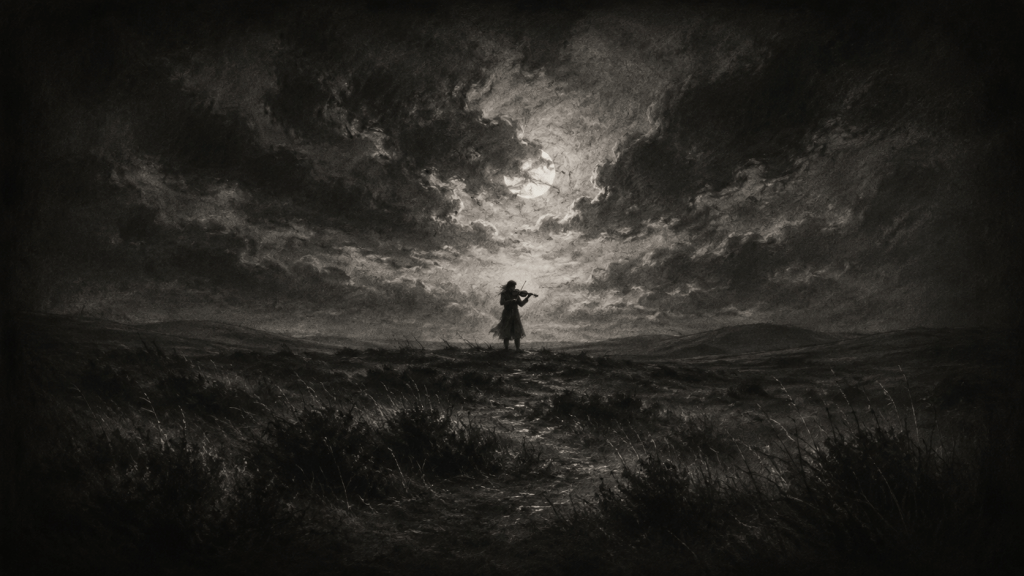
A maestro performs on the moors. Wind sweeps through his matted black hair, and moonlight shimmers in his grey eyes. With his bow, he pulls life from the strings of his mother’s violin, confessing to the night the agonies of his heart.
This is his debut. It will be his only performance.
He offers it as tribute.
Listen.
Isn’t it beautiful?
About the Author and Story

Nikolai Lysewycz is a writer, teacher, and musician based in Germany. Originally from Australia, he teaches English and Music at a state grammar school (Gymnasium) and plays viola with the Neuss City Sinfonia.
This story was written in the shadow of Sibelius’ Violin Concerto in D Minor, which formed part of the Sinfonia’s repertoire in 2025. The second movement in particular left a mark he couldn’t put down.
Disclaimer: No part of this story’s construction, planning, writing, or editing was conducted with AI. The work has been edited and proofed with the generous help of readers and editors from around the world. The header image is, however, AI-generated — not for lack of ability, but for lack of time.
 Scribbles 'n Staves
Leave a comment